

The modern keyboard market has fragmented into many sizes, layouts, and configurations, which can easily confuse anyone trying to choose the right option. Among these variations, the 60% keyboard has become one of the most discussed and debated layouts. Many people hear the term but are unsure what it actually means, how many keys it includes, or whether it fits their daily workflow. To understand why the 60% keyboard has grown so popular, it helps to explore its design philosophy, structure, advantages, limitations, and real-world usability.
A 60% keyboard is designed around minimalism. Instead of including every key found on a traditional full-size keyboard, it removes entire sections to create a compact and efficient typing tool. This reduction is intentional and not a downgrade in quality. In fact, many enthusiasts prefer a 60% keyboard precisely because it eliminates visual clutter and focuses on essential keys. As workspaces shrink and portability becomes more important, this keyboard size has found a loyal following among programmers, writers, gamers, and mechanical keyboard hobbyists.
Table of Contents
What Exactly Is a 60% Keyboard
A 60% keyboard typically omits the function row, the navigation cluster, the arrow keys in most layouts, and the number pad. What remains is the alphanumeric section and a small number of modifier keys. This results in a keyboard that is dramatically smaller than a full-size or even a tenkeyless keyboard. Despite the reduced footprint, a 60% keyboard still allows access to all standard keyboard functions through layered key combinations.
One defining feature of a 60% keyboard is its reliance on function layers. Since there is no dedicated function row, keys such as F1 through F12 are accessed by holding a function modifier and pressing number keys. The same principle applies to arrow keys, navigation commands, and system shortcuts. While this design requires a short learning curve, many users find that it improves efficiency once muscle memory develops.
Another notable change in a 60% keyboard is the repositioning of certain keys. The escape key is often moved to the number row, replacing the traditional back-tick and tilde location. For users who frequently type code snippets or use markdown formatting, this adjustment may feel awkward at first. Some 60% keyboard layouts solve this by splitting keys or reassigning functions through firmware customization, making the experience highly flexible.
How Many Keys Does a 60% Keyboard Have
The exact number of keys on a 60% keyboard can vary depending on layout standards and customization, but most follow a similar structure. A typical ANSI-based 60% keyboard contains 61 keys arranged across five rows. This number represents roughly sixty percent of a standard 104-key full-size keyboard, which is how the 60% keyboard earned its name.
The layout usually includes fourteen keys on the top row, another fourteen on the second row, thirteen on the third, twelve on the fourth, and eight on the bottom row. ISO versions of the 60% keyboard may include one or two additional keys due to regional layout differences, bringing the total closer to 62 or 63. JIS layouts are rare in the 60% keyboard category, largely due to limited demand and manufacturing constraints.
When compared to full-size keyboards with 104 to 108 keys, the reduction is substantial. However, this reduction does not mean functionality is lost. A 60% keyboard simply compresses those functions into layered inputs, allowing skilled users to perform the same tasks without lifting their hands far from the home row.
Why the 60% Keyboard Omits the Number Pad
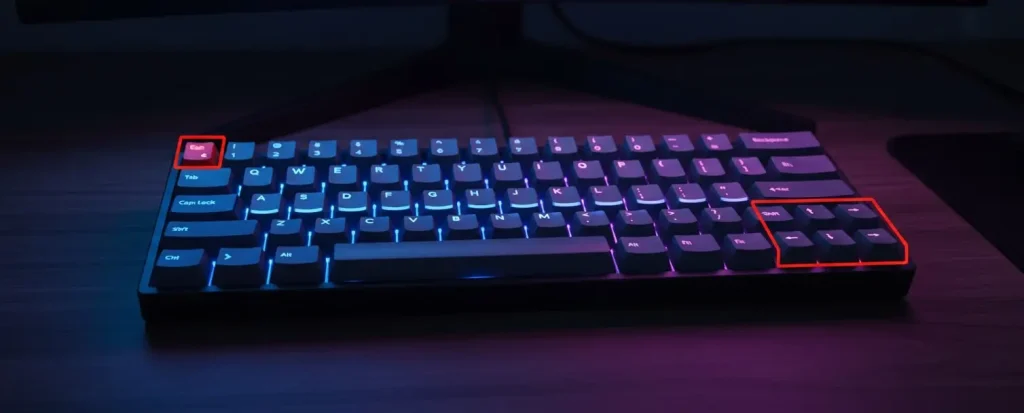
One of the most controversial aspects of the 60% keyboard is the complete removal of the number pad. For professionals who work extensively with numbers, such as accountants, engineers, and data analysts, the absence of a numpad can feel limiting. This is one reason why full-size keyboards remain dominant in finance and administrative environments.
Despite this, many users find that a 60% keyboard encourages faster and more ergonomic typing. Numbers can still be entered using the number row, and some layouts allow the creation of a virtual numpad through function layers. While not ideal for everyone, this trade-off significantly reduces desk space usage and allows for better mouse positioning.
The popularity of the 60% keyboard reflects a shift in priorities. Rather than maximizing the number of keys, users are increasingly focused on comfort, portability, and desk aesthetics. In compact workspaces or shared environments, the reduced size of a 60% keyboard can make a noticeable difference.
Physical Size and Desk Space Advantages of a 60% Keyboard
A 60% keyboard typically measures around 11.5 inches in width and approximately 4.25 inches in depth. This compact footprint is one of its strongest advantages. Compared to tenkeyless or full-size keyboards, a 60% keyboard leaves significantly more room for mouse movement, drawing tablets, or other desk accessories.
This size reduction also contributes to improved ergonomics. Users can position their mouse closer to the keyboard, reducing shoulder strain during long sessions. Gamers, in particular, appreciate the extra space for wide mouse movements, while writers enjoy the clean and uncluttered desk layout that a 60% keyboard enables.
Portability is another major benefit. A 60% keyboard easily fits into a backpack or laptop bag, making it ideal for remote workers, students, and digital nomads. Unlike larger keyboards, it can be transported without hassle, allowing users to maintain a consistent typing experience across different locations.
Mechanical vs Membrane in a 60% Keyboard
Most 60% keyboard models on the market are mechanical rather than membrane. This is largely due to the mechanical keyboard community embracing smaller form factors early on. Mechanical switches offer durability, tactile feedback, and customization options that align perfectly with the philosophy behind the 60% keyboard.
While membrane versions do exist, they are far less common and often targeted at budget buyers. A mechanical 60% keyboard allows users to choose between linear, tactile, or clicky switches, tailoring the typing experience to personal preference. This level of customization is one of the main reasons enthusiasts gravitate toward the 60% keyboard format.
Additionally, mechanical 60% keyboard models often support hot-swappable switches, allowing users to change switches without soldering. This feature further reinforces the idea that a 60% keyboard is not just a tool but a platform for personalization.
Customization Possibilities with a 60% Keyboard
Customization is where the 60% keyboard truly shines. Because of its popularity within the mechanical keyboard community, there is an enormous ecosystem of cases, switches, PCBs, and keycaps designed specifically for this layout. From aluminum and brass cases to polycarbonate and acrylic designs, the 60% keyboard can be tailored aesthetically and functionally.
Printed circuit boards for a 60% keyboard may include RGB lighting, underglow effects, or minimalist unlit designs. Firmware such as QMK or VIA allows users to reprogram every key, redefine layers, and create macros. This level of control transforms the 60% keyboard into a highly adaptable input device.
However, customization comes at a cost. Building a custom 60% keyboard can quickly become expensive, with premium cases alone costing hundreds of dollars. Availability can also be limited, as many high-end components are produced in small batches with long waiting periods.
Programmability and Layer Functions in a 60% Keyboard
Because a 60% keyboard has fewer physical keys, programmability is essential. Most models include one or more function layers that allow keys to serve multiple purposes. By holding a function modifier, users can access arrow keys, media controls, navigation commands, and even macros.
This layered approach may feel unintuitive at first, but many users find that it improves workflow efficiency over time. Instead of reaching for distant keys, commands are executed through compact finger movements. In this sense, a 60% keyboard encourages a more intentional and mindful typing style.
Macro support further enhances the power of a 60% keyboard. Although limited by the number of available keys, macros can automate repetitive tasks and streamline workflows. For programmers and power users, this feature often outweighs the absence of dedicated keys.
Who Should Choose a 60% Keyboard
The 60% keyboard is not a universal solution, but it excels in specific scenarios. Users with limited desk space, frequent travelers, and those who value minimalist aesthetics often find the 60% keyboard ideal. Gamers appreciate the increased mouse space, while writers enjoy the focused typing environment.
On the other hand, users who rely heavily on function keys, arrow clusters, or numeric input may prefer larger layouts. While a 60% keyboard can technically perform all these functions, the learning curve may not be worth it for everyone.
Ultimately, choosing a 60% keyboard is about priorities. It trades physical keys for flexibility, size reduction, and customization. For many, that trade-off results in a more enjoyable and efficient typing experience.
The Growing Popularity of the 60% Keyboard
The rise of the 60% keyboard reflects broader trends in technology and work culture. As remote work becomes more common and personal workspaces become more compact, users are seeking tools that adapt to their environment. The 60% keyboard answers this demand with a balance of form and function.
Online communities, custom builds, and social media have also fueled interest in the 60% keyboard. Enthusiasts share layouts, builds, and modifications, turning the keyboard into a creative outlet. This sense of ownership and personalization is difficult to replicate with mass-produced full-size keyboards.
As manufacturers continue to innovate, the 60% keyboard is likely to remain a central figure in the mechanical keyboard world. Whether purchased pre-built or assembled from scratch, it represents a deliberate move away from excess and toward thoughtful design.
Final Thoughts on the 60% Keyboard
A 60% keyboard is more than just a smaller keyboard. It is a design philosophy that emphasizes efficiency, customization, and intentional use. By removing rarely used keys and relying on programmable layers, the 60% keyboard offers a powerful and adaptable typing experience in a compact form.
When fine-tuning the typing experience on a 60% keyboard, many enthusiasts go beyond layout and programmability and begin focusing on feel and comfort. Switch selection plays a major role here, and some users specifically gravitate toward Cherry Black Switches for their heavier linear resistance and consistent keystroke, especially when accuracy matters more than speed. Long typing sessions on a compact keyboard can also benefit from proper ergonomics, which is why Wrist Wrests are often paired with a 60% keyboard to reduce strain and maintain a neutral hand position despite the reduced footprint.
On the customization side, advanced builders sometimes explore modular DIY solutions and experimental electronics through Kits like nullbits, which allow deeper control over firmware behavior, lighting, and input logic, pushing the 60% keyboard beyond a simple input device and closer to a fully personalized interface.
While it may not suit every user, its continued popularity suggests that many people are willing to rethink how they interact with their keyboards. For those willing to invest time in learning and customization, the 60% keyboard can become a highly personal and satisfying tool that fits seamlessly into modern workflows.
Share This Article
Found this helpful? Share it with others who might benefit.